If you've been comparing St. Petersburg to other Tampa Bay neighborhoods this year, you've probably run into a contradiction. One data point says condo prices in Pinellas County are up sharply year over year. Another says St. Petersburg's overall housing inventory just hit its highest level in roughly a decade, with homes sitting on the market longer than they have in years. Both of those things are true. They're just not describing the same buildings.
The county-wide condo number and the on-the-ground buyer experience have split apart this year, and the gap between them is wide enough that relying on the headline price alone will point you at the wrong building. Understanding why requires looking past the median and at what's actually closing.
Where the 26 percent came from
Earlier this year, the median condo price across Pinellas County rose about 26.5 percent compared to the year before, with total dollar volume more than doubling over the same stretch. On paper, that reads like a market on fire. In practice, it's a handful of very large closings doing very heavy lifting on a countywide average.
Two downtown St. Petersburg towers explain most of it. Art House, the 244-unit Kolter Urban tower at 275 1st Avenue South, topped out in late 2024 and reached full completion in early 2026. It's now more than 90 percent sold, with remaining units priced from roughly $1.3 million to over $7 million. A few blocks away, the 46-story Residences at 400 Central received a temporary certificate of occupancy on its first 25 floors and residents began moving in shortly after. When dozens of million-dollar-plus units close in the same reporting window, they don't just add to a county median, they distort it. A handful of these sales can make an entire county's condo statistics look like a different market than the one most buyers are actually shopping in.
More of this is coming. Downtown St. Pete has a pipeline that includes the Waldorf Astoria Residences, a proposed 49-story, 164-unit tower that would become the city's first hotel-branded condominium, and the Roche Bobois Residences, a 29-story, roughly 165-unit project from Clearwater-based Valor Capital with construction expected to begin this year. Each new tower that closes out its units will keep feeding the same statistical effect for a few more reporting cycles.
What you'd actually see on a tour
Step outside the luxury tower segment and the story flips. As of this month, St. Petersburg's overall housing inventory sits at its highest point in about ten years. Average days on market have climbed to 59, up from 47 a year ago. That slower pace is even more pronounced in the condo segment specifically. Pinellas County condo and townhome supply has pushed past 13 months, deep into buyer's market territory, while single-family homes in the same county sit at roughly 3 to 4 months of supply.
| Segment (Pinellas County) | Months of supply |
|---|---|
| Single-family homes | 3 to 4 months |
| Condos and townhomes | 13+ months |
That's not a small gap. It's the difference between a market where well-priced single-family homes still move quickly and a condo market where sellers are cutting prices and buyers can take their time.
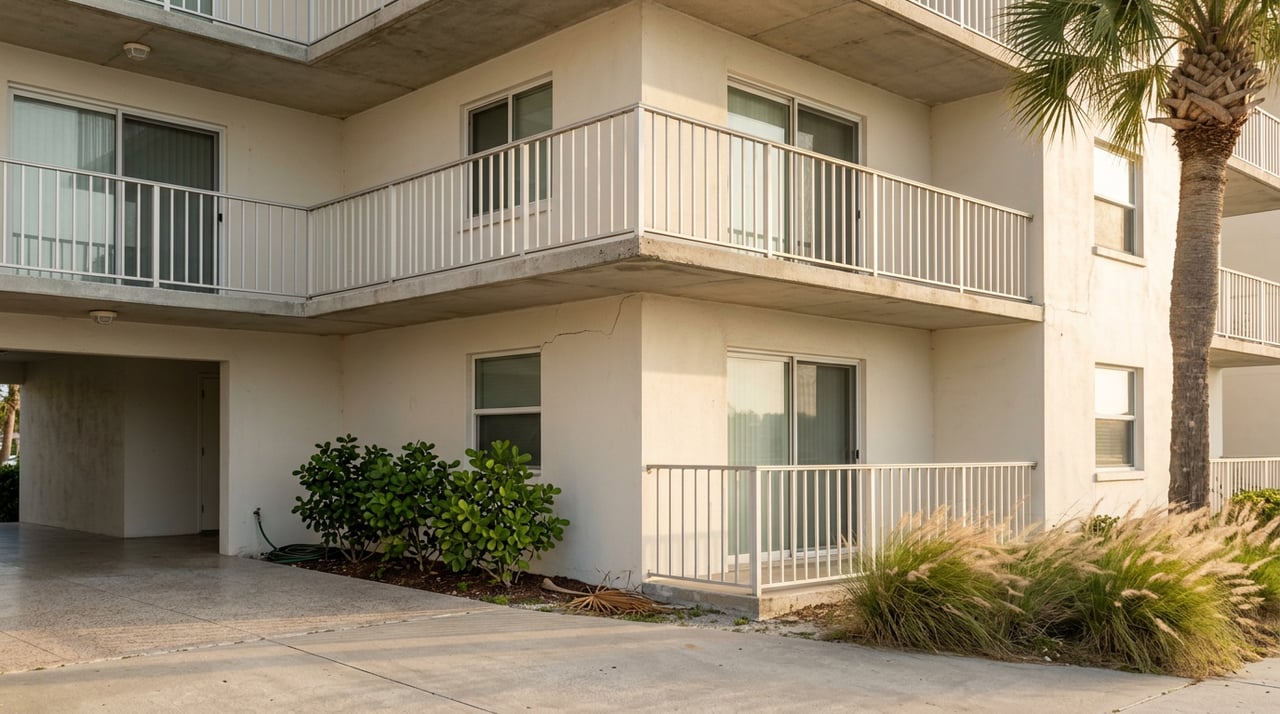
This slower pace is concentrated in older buildings, many built in the 1960s through the 1990s, in and around Isla del Sol, Tierra Verde, Snell Isle, Shore Acres, Old Northeast, and Gateway. These aren't struggling neighborhoods. They're some of the most established waterfront-adjacent communities in the city. What they share is age, and age is exactly what's driving the divergence right now.
Why the split exists
The mechanism here isn't mysterious once you know where to look, and it comes down to what changed in Florida condo law after the Surfside collapse.
Buildings three stories or taller are now required to complete a Structural Integrity Reserve Study, and for most existing owner-controlled associations that study needed to be finished by December 31, 2025. There's one narrow exception: if a building's milestone inspection is due on or before December 31, 2026, the association can complete its SIRS at the same time, but never later than that date. Associations can no longer vote to waive or underfund reserves for structural components once identified in a SIRS, and the statutory reserve funding threshold under House Bill 913 rose from $10,000 to $25,000, with the official 2026 inflation-adjusted figure set at $25,675.
For a building that spent decades keeping dues artificially low by skipping reserve contributions, this is the year the bill arrives. Some associations that historically collected $50 to $100 per month per unit in reserves now need $300 to $800 per month to comply. Where that gap is large enough, boards are levying special assessments that have ranged from $20,000 to well over $100,000 per unit. Industry analysis of completed reserve studies found that roughly 30 percent of associations are funded below 50 percent, the point at which a special assessment becomes highly likely rather than a remote risk.
There's a financing consequence too. More than 1,400 Florida condo buildings currently sit on Fannie Mae's restricted list, which makes them non-warrantable and cuts off standard conventional financing for buyers. A building can look fine in listing photos and still fail this test.
New downtown towers largely sidestep all of this. Buildings that opened in the last few years were designed and funded under the current rules from day one, with no decades of deferred maintenance to catch up on. That's a real structural advantage, not just a marketing one. It's also why the price growth is concentrated where it is: buyers are paying for a building with a clean compliance slate, not just a nicer lobby.
What to ask before you write an offer
In this market, the unit and the building have effectively become two separate purchases, and the second one deserves its own due diligence. Before you get attached to a condo anywhere in St. Petersburg, work through this list.
- Request the milestone inspection report and the Structural Integrity Reserve Study for that specific building, not a generic association disclosure summary.
- Ask what percentage funded the current reserve study shows. A number under 50 percent is a flag worth taking seriously.
- Pull the last 12 to 24 months of board meeting minutes and look for any discussion of repairs, structural findings, or budget shortfalls.
- Confirm whether the building appears on your lender's non-warrantable or restricted list before you write an offer contingent on conventional financing.
- Look at how HOA dues have moved over the past two years, not just what they are today. A steep recent jump often signals a reserve catch-up already underway.
Florida law now also gives condo buyers a seven-day window to review financial and inspection documents before being bound to a purchase agreement. Use it. That week exists specifically so this kind of review can happen before you're locked in.
What this means depending on what you're shopping for
If you're drawn to downtown St. Petersburg's newer towers for the lifestyle and the clean compliance picture, that instinct is reasonable, but it doesn't mean due diligence stops. Even a building funded correctly today will eventually face its own reserve decisions as it ages, and paying attention to how a board plans for the long term matters regardless of the building's age.
If you're looking at older waterfront-adjacent buildings in Snell Isle, Shore Acres, or similar established pockets because the price looks like a discount, that discount might be a genuine opportunity in a well-managed building, or it might be pricing in real risk that hasn't surfaced yet. The only way to tell the difference is reading the documents, not the median.
If you're weighing St. Petersburg against another Tampa Bay neighborhood based on a countywide price chart, recognize that a single median for a market this fragmented tells you very little about any specific building you'd actually consider buying.
None of this shows up cleanly in a portal listing. It shows up in a reserve study, a set of board minutes, and a conversation about what a specific association has and hasn't funded. If you want a second set of eyes on a building before you write an offer, or you're trying to figure out which St. Petersburg submarket actually fits what you're looking for, Fast Florida Real Estate can walk through the documents with you before you're under contract, not after. Let's Connect.
A few questions worth asking directly
Does this mean older St. Petersburg condo buildings are a bad investment right now? Not automatically. Many older associations are well managed, fully reserved, and priced fairly for what they offer. The point isn't to avoid older buildings, it's to confirm which category a specific building falls into before you commit.
Can I still get a mortgage on an older condo in St. Petersburg? Often yes, but not always. With more than 1,400 Florida buildings currently on Fannie Mae's restricted list, it's worth confirming a building's warrantable status with your lender early, ideally before you fall in love with a unit.
Should I just wait for condo prices to drop further before buying? That depends on the building more than the calendar. A well-reserved building in a slower market can still be a sound purchase today, while an underfunded building may carry the same assessment risk regardless of when you buy. The building's fundamentals matter more here than trying to time the broader market.